Case note · Anonymized
Recovery Is Not a Straight Line
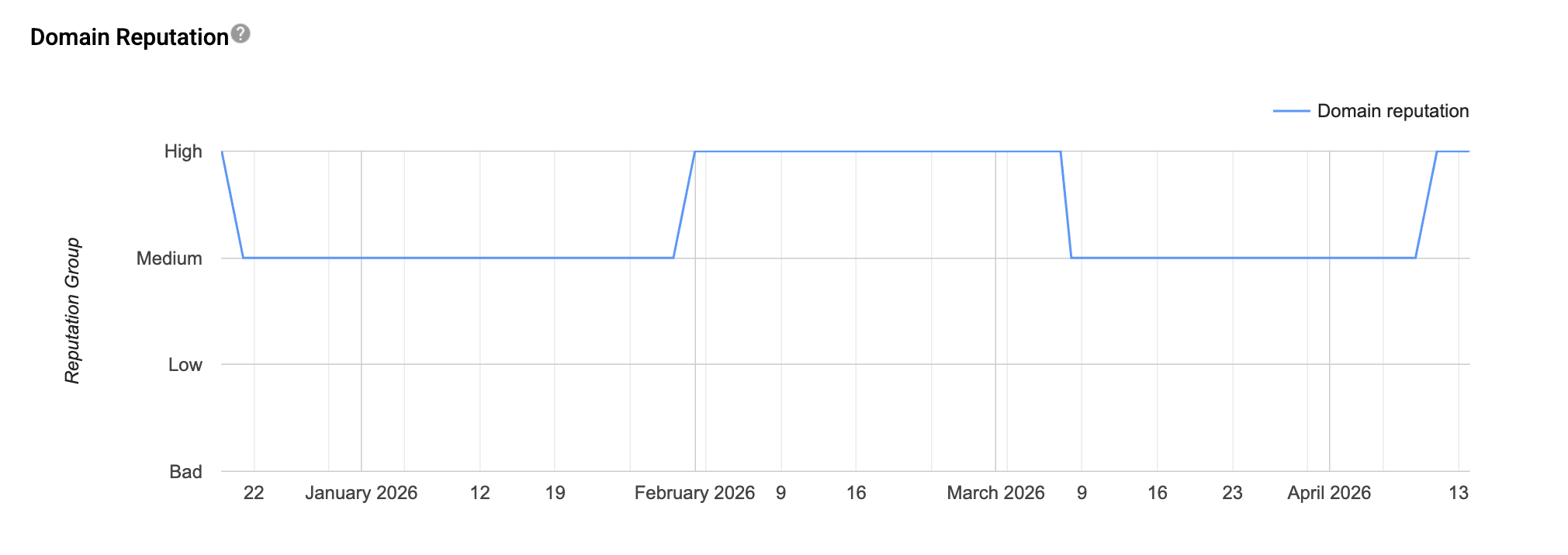
Google Postmaster, domain reputation, December → April. Client domain anonymized.
This domain lives at High. But look at the curve: two distinct drops to Medium in four months — late December and early March. Both were self-inflicted, both were visible within two weeks, and both recovered. This is what real sending looks like: not a clean line, but a pattern you learn to read.
Drop one: the holiday spike (December)
Peak season. The team roughly doubled daily volume almost overnight and mailed deeper into the list than usual — subscribers 180+ days inactive — because holiday revenue targets were staring at them. Engagement per send diluted, complaint rate ticked up, and within about two weeks Postmaster showed Medium.
The response was boring and correct: volume back to normal, back to engaged-first segments, ride it out. By early February the domain was back at High — roughly six weeks of discipline to undo two weeks of enthusiasm.
Drop two: one campaign (March)
The second drop wasn't a season — it was a single send. A re-engagement campaign to a cold segment, one blast. One send, visible damage. The fix was the same routine, and recovery took about four weeks.
I want to underline that: one campaign can move your reputation. People imagine reputation damage as a slow leak. Sometimes it's a single afternoon.
What this curve teaches
- Reputation is a trailing indicator. The curve you see today scores what you did one to three weeks ago. By the time Medium shows up, the damage is already done — which is why "we'll pull back if the numbers move" is always a late strategy.
- Medium is a warning light, not a catastrophe. Every sender will visit Medium eventually. The mistake isn't landing there — it's staying there because you kept doing the thing that caused it.
- Relapses get more expensive. A domain that oscillates between High and Medium teaches Gmail that its good behavior isn't stable. Each recovery takes a little longer than the last. The goal isn't "fix it when it drops" — it's to stop doing the thing that drops it.
- Seasonal volume needs a ramp, not a cliff. If you're going to double volume for the holidays, build toward it over weeks with engaged segments first. Gmail tolerates growth. It punishes discontinuity.
For the full diagnostic sequence when your own curve moves, see the open-rate-drop workflow. And for the recovery mechanics by reputation level, the domain reputation guide.
Discuss
Has a single campaign ever moved your reputation? What did it cost you? Email me — ohmysendcom@gmail.com. I read everything.
Want me to watch your curve with you? Here's how that works.